
Walker County Court Records After a Jail Arrest
Walker County arrest records and court charges are related, but they are not the same record. The custody side begins when a sheriff deputy, municipal police officer, state trooper, or other agency books a person into the Walker County Jail or Jasper City Jail. The court side begins when a complaint, information, indictment, citation, or other charging document places the matter into District Court, Circuit Court, municipal court, or another proper court channel.
The Walker County District Attorney represents the State of Alabama and prosecutes felony, misdemeanor, and juvenile cases that occur in the county. Jail staff document custody and booking facts, but prosecutors and courts control the formal charge record. For the custody snapshot, use Walker County jail inmate records. For booking-photo availability and the limits of the current public web roster, use Walker County jail mugshots. For hearings, case status, costs, filings, and disposition, use the Circuit Clerk, Alacourt, or the issuing municipal court.
The official jail rules make an important local distinction: Walker County Jail staff do not set court dates. Court-date questions should go to the inmate, attorney, court record, or clerk. If a person is physically in custody, the jail remains the right contact for custody confirmation. If the question is whether a charge was amended, dismissed, indicted, diverted, or resolved, the court record is the better source.
How to Find Walker County Court Records After an Arrest
Walker County criminal case records are handled through the Walker County Circuit Clerk and Alabama's court-access systems. The Circuit Clerk is the court-record custodian for District and Circuit Court records, including District Criminal and Circuit Criminal matters. Alacourt Access is the statewide paid public case-search portal for criminal, civil, small claims, state traffic, domestic relations, and child support records.
- Start with the booking fact: name, arrest date, arresting agency, and initial charge or hold reason from the jail, app, phone, or in-person channel.
- Open Alacourt Access and search by defendant name if the case number is unknown.
- Search by case number when a clerk notice, attorney, citation, warrant, or court document gives one.
- Open the case detail and read the charge list, case status, setting dates, court actions, financial history, and case action summary.
- Use document images only when needed because Alacourt lists image fees separately from the basic search.
- If no case appears online, call or visit the Walker County Circuit Clerk because very recent arrests, older records, municipal matters, or cases waiting on indictment may require a local court check.
Alacourt Access is the official public portal to check first for paid statewide case access. The captured source page shows the system's public search types, record coverage, and report options.
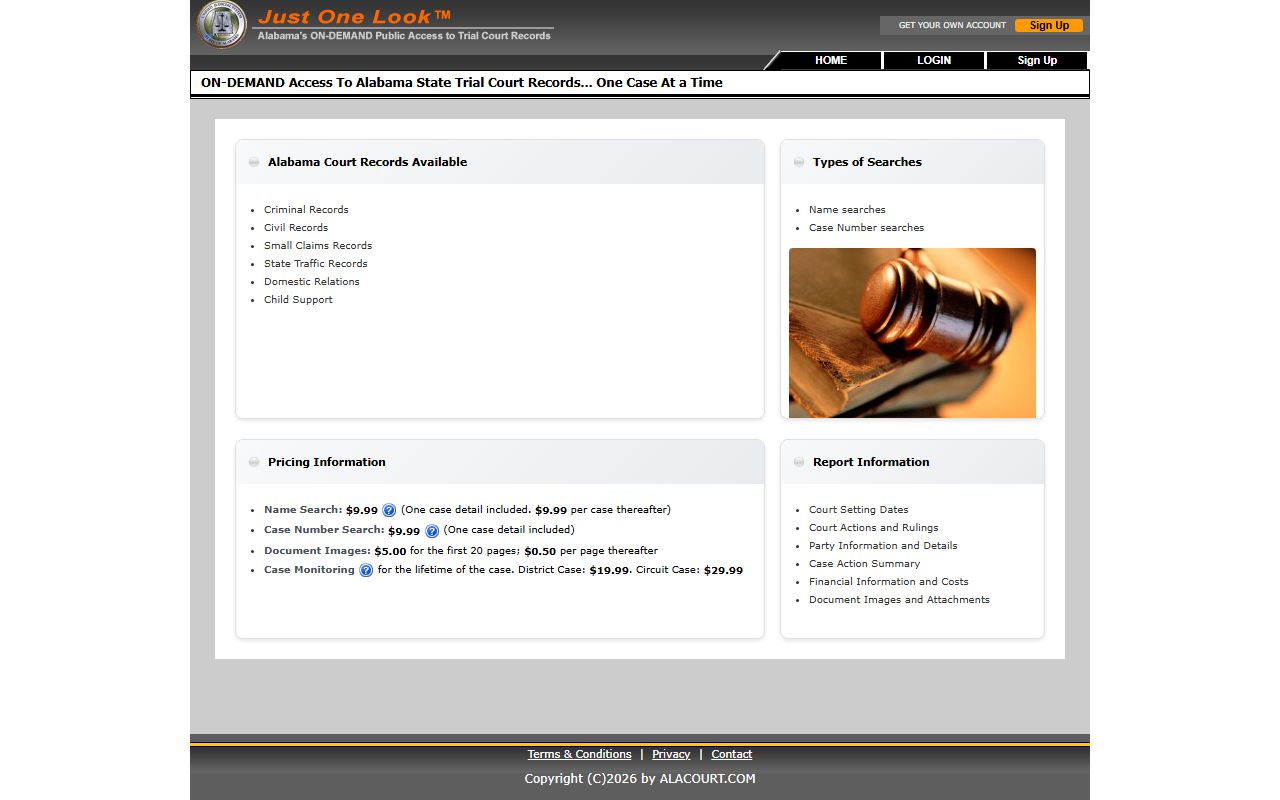
That source matters because Walker County court records after an arrest may show the formal case path even when the original booking record has limited detail or no current web profile.
| Alacourt Field or Item | Type | Cost or Note | Use After Arrest |
|---|---|---|---|
| Name search | Search path | $9.99 shown on source page | Use when the booking record or family contact does not provide a case number. |
| Case number search | Search path | $9.99 shown on source page | Use when the clerk, attorney, citation, warrant, or court notice gives the number. |
| Document images | Add-on | $5.00 for first 20 pages, then $0.50 per page | Use for filings or attachments when case detail is not enough. |
| Case monitoring | Add-on | District case $19.99; Circuit case $29.99 | Useful when a pending charge needs ongoing setting or action updates. |
| Subscriber portal | Account login | $150 AOC setup fee plus monthly plan in service agreement | Mainly for legal or background users needing repeat access. |
Alacourt is not the same thing as an ALEA criminal-history check. Alacourt shows court case details and actions. ALEA criminal-history products are separate from a casual jail or court lookup and should be used only through the proper state process.
Charging Documents After Arrest
After a Walker County arrest, the booking charge may be only the first public clue. A prosecutor can file a charge, amend a charge, reduce it, dismiss it, or present it to a grand jury depending on the facts and the level of the offense. The magistrate warrant process can also feed into the court record when a victim fills out a deposition, testifies under oath, and a magistrate finds probable cause for a warrant.
| Document | Filed By | Common Use | Walker County Record Impact |
|---|---|---|---|
| Complaint | Officer, complainant, or prosecutor depending on procedure | Lower-court or early criminal proceedings | May start the case or support a warrant after probable cause is found. |
| Information | Prosecutor | Prosecutor-filed charging document in some cases | Shows the charge the State chooses to pursue, which can differ from the booking wording. |
| Indictment | Grand jury | Felony prosecution and serious cases | May appear after the arrest, and it may add, change, or refine the original charge. |
The Walker County District Attorney site does not publish a detailed charging manual. For exact case filings, use the Circuit Clerk or Alacourt. For municipal citations or bench warrants, the issuing municipal court may be the first public contact before an appeal reaches Circuit Court.
Charge Status and What It Means
A court charge is a moving record. It can be pending while the case is open, amended when the prosecutor changes the wording or code, reduced through plea discussions or review, dismissed by the court, or ended by nolle prosequi when the prosecutor declines to proceed. Because the jail record is a custody snapshot, it may continue to reflect the initial reason for confinement while the court record shows the current formal status.
| Status | What It Means | What to Check |
|---|---|---|
| Pending | The charge is open and has not reached final disposition. | Review setting dates, bond orders, and case action summaries. |
| Amended or Reduced | The filed charge changed from the original booking or earlier court wording. | Compare the current charge list to earlier entries and orders. |
| Dismissed | The court ended the charge without a conviction on that count. | Check whether other counts, holds, or cases remain active. |
| Nolle Prosequi | The prosecutor chose not to proceed on that charge. | Confirm whether the arrest record remains and whether expungement may be available. |
| Diversion | An eligible case may follow a diversion path instead of ordinary conviction and sentencing. | The Walker County DA site describes DUI Pre-Trial Diversion for certain first-time, nonviolent defendants. |
| Convicted or Adjudicated | The charge resulted in a plea, verdict, or adjudication. | Read the disposition, sentence, costs, probation terms, or transfer order. |
Bond and Release After an Arrest
Bond information often sits between the jail and the court. The Walker County Jail houses the person and can confirm custody or holds, while the magistrate, judge, clerk, and bonding process control court authority and bond paperwork. The Circuit Clerk page says the clerk serves as a fiscal and administrative officer for court money, costs, fines, restitution, judgments, and bonds, and the clerk bio describes roles connected to warrants, bail, bonding-company qualification, bond approval, and court information flow.
Walker County has one specific jail-page rule that should be checked before any release attempt: when bonding out an inmate, bring a $35 money order made payable to the "Circuit Clerk." The jail page states that this amount is required by Alabama law and is separate from any money or property needed for a cash or property bond.
| Bond Type | How It Works | Walker County Note |
|---|---|---|
| Cash Bond | The full required amount is paid in acceptable funds. | The separate $35 Circuit Clerk money order is still required when bonding out. |
| Property Bond | Real property is pledged to secure appearance. | The jail page separates property bond money or property from the $35 money order. |
| Surety Bond | A licensed bondsman posts bond under a contract and fee arrangement. | The Circuit Clerk role includes pre-qualifying and monitoring bonding companies. |
| PR or Own Recognizance | A court releases a person on a promise to appear, usually without full cash payment. | No Walker County source confirmed availability for any particular case. |
| No-Bond Hold | The person cannot be released on that charge or hold. | Another county, state, federal, probation, parole, ICE, or court hold may prevent release even if one bond is posted. |
Warrants That Lead to an Arrest
Walker County's official magistrates page is the clearest local warrant source. It says magistrates are part of the judicial branch and must use independent judgment when issuing arrest warrants. Misdemeanor warrant jurisdiction covers offenses outside municipal city limits. Felonies, traffic matters, and worthless checks are handled under the county jurisdiction rules listed by the court page.
The Walker County magistrates and warrants page explains the local warrant process, including the police-report requirement, deposition, sworn testimony, probable-cause decision, and the rule that there is no cost to start that warrant process.
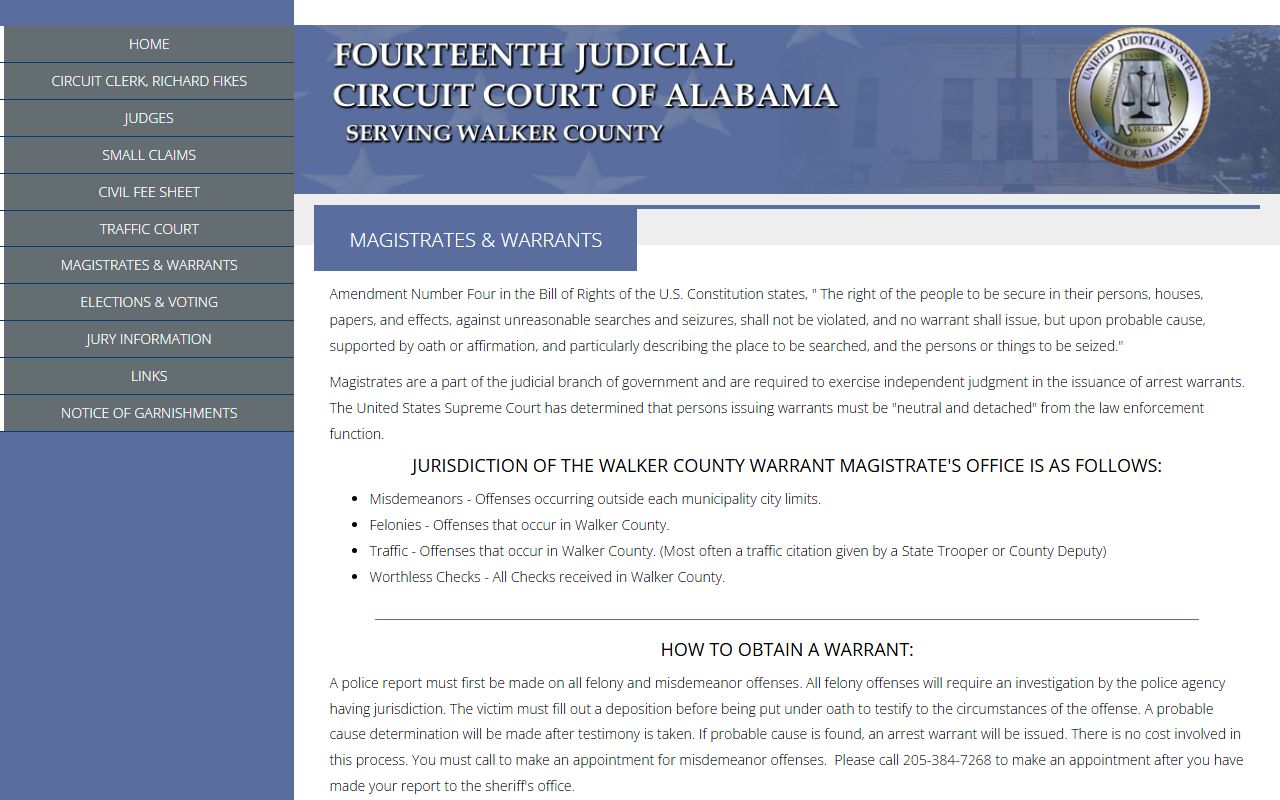
The same warrant source creates an important access limit: an unserved arrest warrant is not a public record. A person who suspects an active warrant against himself or herself must appear in person at the Walker County Sheriff's Office, 2001 2nd Avenue, Jasper, AL 35501, or call the sheriff's main non-emergency number, 205-302-6464, for proper direction. For misdemeanor warrant appointments after a report, the court page lists 205-384-7268.
Charges vs. Convictions
An arrest, a booking charge, and a filed court charge are accusations or process steps. A conviction is a later court outcome after a plea, trial, or adjudication. The sheriff's public-facing arrest-photo disclaimer states that an indication of arrest does not imply guilt and that all persons are presumed innocent until proven guilty in a court of law.
| Charge | Conviction | |
|---|---|---|
| Stage | Accusation, booking reason, or filed count | Final result after plea, verdict, or adjudication |
| Proof Level | Often starts with probable cause or prosecutor review | Requires proof beyond a reasonable doubt or a valid plea |
| Public Record | Often public unless protected, sealed, juvenile, or exempt | Often public unless protected, sealed, juvenile, or expunged |
| Best Source | Jail record for booking, Alacourt or clerk for filed charges | Court disposition, sentencing order, or certified clerk record |
Sealed vs. Expunged Arrest Records
Alabama public-record law favors access to public writings, but public access is not unlimited. Juvenile records, medical records, active investigative material, sealed files, expunged records, and records protected by another law may be withheld or redacted. Ala. Code Section 15-27-1 and Chapter 15-27 allow expungement of qualifying criminal records in certain circumstances. ALEA's expungement page also makes a key point: courts grant expungements, not ALEA.
| Sealed | Expunged | |
|---|---|---|
| Visibility | Hidden or restricted from ordinary public access by court order or rule. | Treated under Alabama expungement law as removed from ordinary public criminal-record access when granted. |
| Who Acts | The court controls sealed court files and protected access. | The court grants eligible expungement relief under Chapter 15-27. |
| Public Lookup Impact | Alacourt, clerk access, and public copies may omit or restrict the record. | Official agencies use the expungement order and statutory process to address records. |
| Limits | Law enforcement, courts, or authorized users may retain limited access. | Eligibility depends on the charge, disposition, waiting periods, and statutory requirements. |
Walker County Arrest Record Contacts
Use the correct office for the record needed. The jail is for custody confirmation, booking, and bond-release logistics. The Circuit Clerk is for court files, case status, copies, older records, and hearing information. The District Attorney is the prosecution office, but exact public filings should still be checked through clerk or court channels.
The Walker County Circuit Clerk page lists the courthouse contact details and public court-record role for local cases.
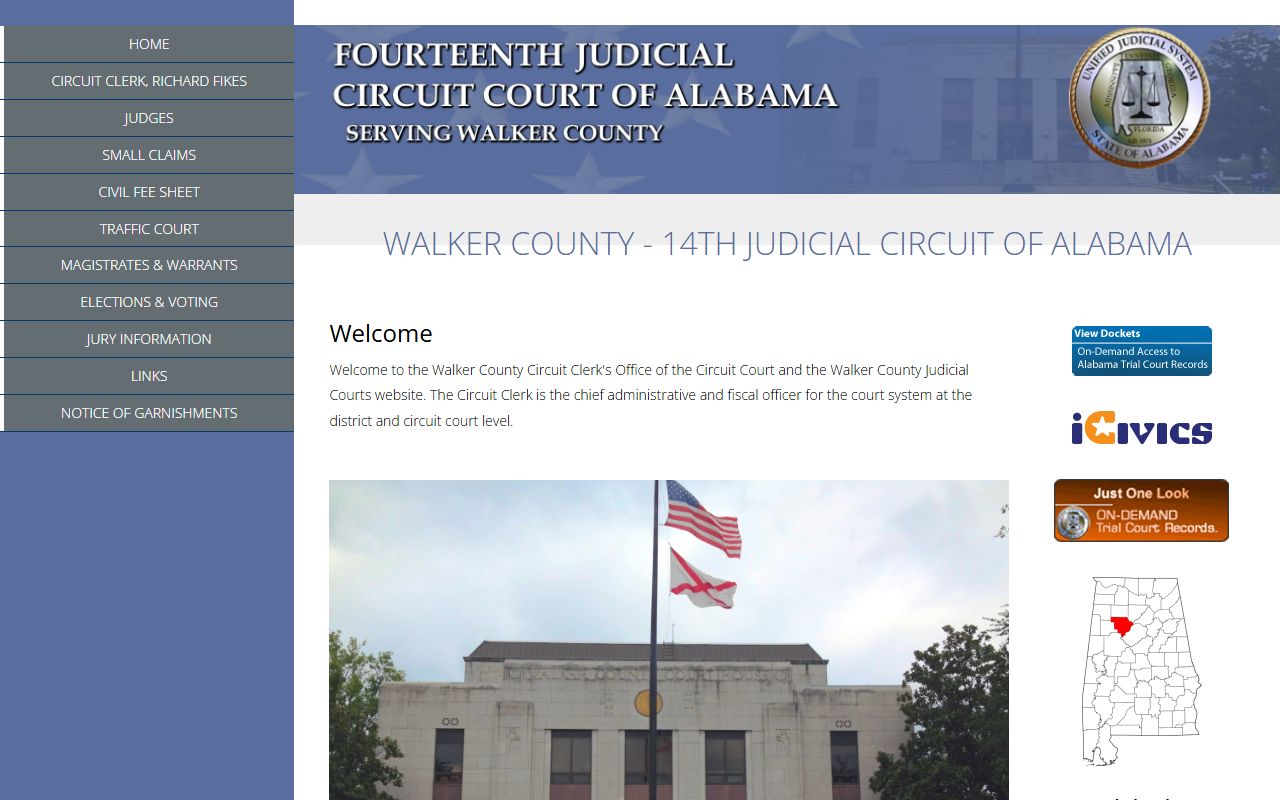
That clerk source is the practical fallback when Alacourt does not show a recent arrest case or when a certified copy is needed.
| Office | Address | Phone | Use For |
|---|---|---|---|
| Walker County Circuit Clerk | Walker County Courthouse, 1803 3rd Avenue, Suite 205, Jasper, AL 35501 | 205-384-7268 | District and Circuit Court records, case status, copies, court access questions. |
| 14th Judicial Circuit Courts | Walker County Courthouse, Second Floor, 1801 Third Ave S, Jasper, AL 35501 | 205-384-7268 | Court system links, courthouse hours, Alapay, Alafile, and Alacourt routing. |
| Walker County District Attorney | 11 18th St E, Jasper, AL 35501 | 205-384-7011 | State prosecution of felony, misdemeanor, and juvenile cases in Walker County. |
| Walker County Sheriff's Office and Jail | 2001 2nd Avenue, Jasper, AL 35501 | 205-302-6464 | Custody, booking, jail records, bond-release logistics, and in-person warrant direction. |
Background Check Considerations
Casual court-record lookup is not the same as a regulated background check. A person checking a Walker County court case for personal knowledge should still read the current status and disposition carefully, because a booking charge can be dismissed, reduced, diverted, or resolved without becoming a conviction. Employment, tenant screening, credit, insurance, and other regulated uses require lawful FCRA-compliant processes and current, verified records.
Important: This private site is not a consumer reporting agency and must not be used for FCRA-covered screening decisions.
Restricted Court Records After an Arrest in Walker County
Alabama law allows inspection and copying of many public writings under Ala. Code Section 36-12-40, and sheriffs must keep a public prisoner record under Ala. Code Section 36-22-8. Those rules do not make every arrest-related item public. Active investigative files, evidence photos, witness statements, internal notes, juvenile matters, medical records, sealed court files, and expunged records may be restricted. Ala. Code Section 12-21-3.1 is a useful supporting authority for law-enforcement investigative material, which is separate from the basic sheriff jail book.
The practical rule is simple: use the sheriff for the public prisoner record and custody facts, use the clerk or Alacourt for filed court records, and expect some material to be redacted or withheld when another statute, confidentiality rule, security issue, juvenile restriction, expungement order, or active-investigation concern applies.